What is Title IX?
Title IX of the Education Amendments of 1972 is a federal civil rights law that protects people from discrimination based on sex/gender in federally-funded education programs and activities. As a recipient of federal funds and an institution that values equity and inclusion, Lafayette College must comply with Title IX.
What is the Clery Act?
The Clery Act requires all colleges and universities that receive federal aid to keep and disclose information about crime within set geographic parameters. Compliance is monitored by the United States Department of Education, which can impose civil penalties against institutions for each infraction and can suspend institutions from participating in federal student financial aid programs. Schools are required to publish an annual security report, maintain a public crime log, give timely warnings of crimes that represent a threat to the safety of students or employees, and keep the most recent eight years (as of 2012) of crime statistics that occurred. Lafayette College’s ASR can be found here. Timely warnings are sent via Leopard Alert and College email.
What is the difference between Title IX and Clery?
Title IX is a federal civil rights law that prohibits sex discrimination and applies to schools that receive federal funding. The Clery Act requires institutions of higher education to notify the community about certain public safety and crime prevention matters. The two laws are very different but have some important similarities, particularly after the Violence Against Women Reauthorization Act of 2013 amended Clery.
Who is the College's Title IX Coordinator?
The following individual has been designated as the Title IX Coordinator for Lafayette College:
Karen A. Salvemini
006 Markle Hall
Easton, PA 18042
610-330-5649
salvemik@lafayette.edu
sash.lafayette.edu
Are any College individuals required to report incidents of bias, harassment, discrimination, and/or sexual misconduct (sexual assault, dating violence, domestic violence, stalking)?
Yes, pursuant to the College’s policies addressing equal opportunity, harassment, non-discrimination, and Title IX, all faculty, staff, administrators, resident advisors, and Lafayette Extended Orientation Leaders (LEOs) are required to report incidents of bias, harassment, discrimination, and/or sexual misconduct that involve students, whether the reporter witnesses the behavior or is informed of the behavior by the impacted student or another individual who became aware of the incident.
In addition, College managers and supervisors must report incidents that they become aware of that involve any College employees and and any form of bias, harassment, discrimination, and/or sexual misconduct.
What happens after I report?
A report to the Director of Institutional Equity/Title IX Coordinator does not typically automatically trigger an institutional disciplinary process.
If you are the complainant:
After you report an incident of bias, harassment, discrimination, and/or sexual misconduct, you will be contacted, usually via email, by the Director of Institutional Equity / Title IX Coordinator to share information with you about your options moving forward. One of those options will be an invitation to an informational meeting with the Director of Institutional Equity/Title IX Coordinator. This informational meeting is intended to answer questions regarding resources, discuss available supportive measures, and institutional procedures–it does not automatically trigger an investigation of the reported conduct.
If you are a third-party reporter:
After you submit a report, the Director of Institutional Equity/Title IX Coordinator, or designee, will acknowledge receipt of the report and may have some follow-up questions for you. You are welcome to request a meeting with the Director of Institutional Equity/Title IX Coordinator or Deputy Title IX Coordinator at any time if you have questions.
If you submit an anonymous report:
The College is limited in its ability to respond to anonymous reports. You should not expect to receive a follow-up communication if you report anonymously; however, the College may attempt to gather additional information about any reported incidents. Anonymous reports will be kept on record, and if enough information is available, may be recorded in the school’s crime statistics.
Click here to access the Resource Guide
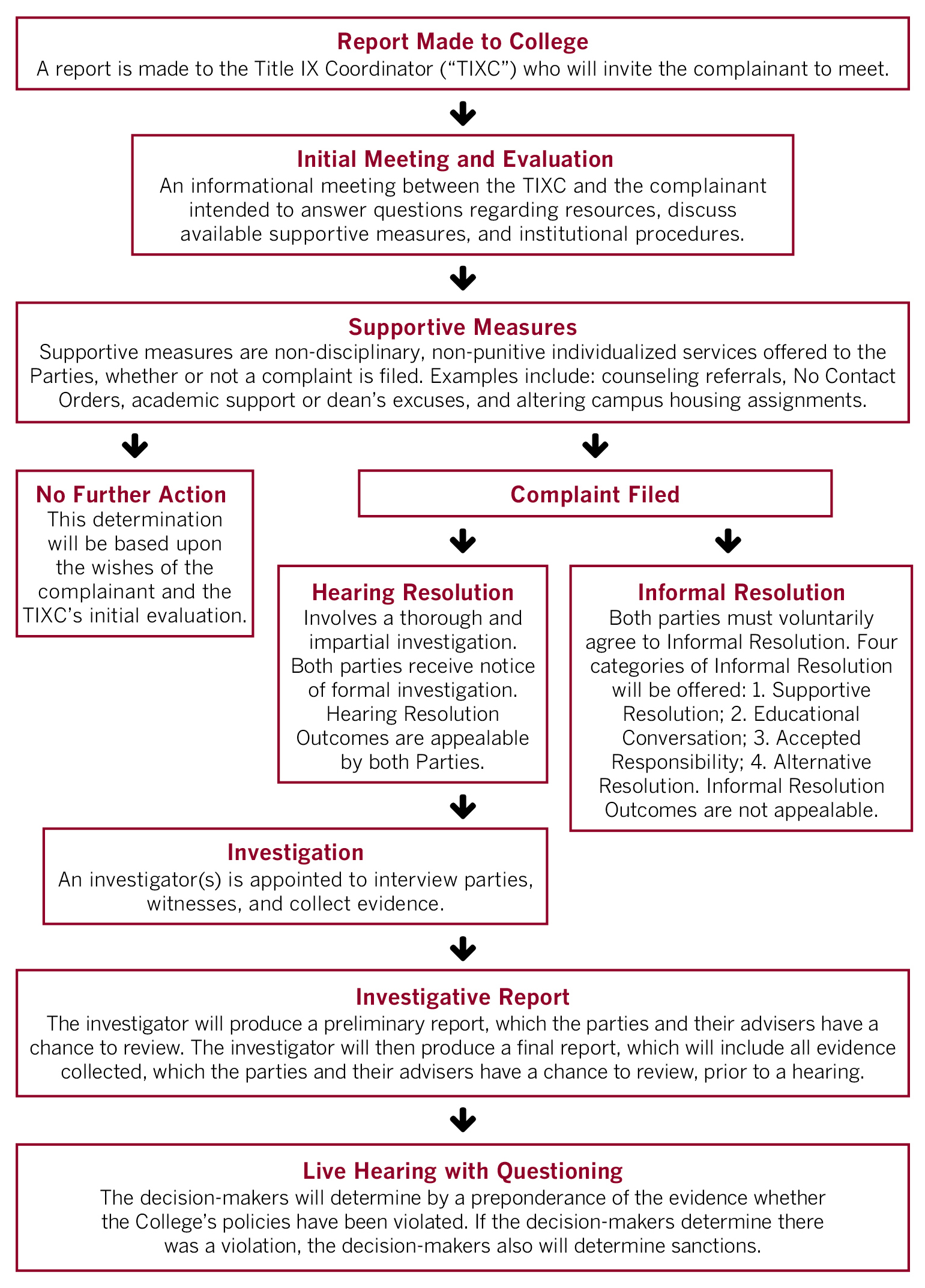
Below is a flowchart explaining the different outcomes after reporting:
Is the College going to inform the community about my situation?
Only in extremely limited circumstances.
The Clery Act requires institutions to issue timely warnings to the campus community about crimes that have occurred and may continue to pose a serious or ongoing threat to students and employees. The Department of Public Safety is responsible for determining if a timely warning must be sent out after a crime is reported. Such warnings will never contain names or other identifying information about victims.
In addition, the Department of Public Safety maintains a crime log for all crimes (including crimes of sexual violence) as defined by the Clery Act. Identifying information will not be included in the campus crime log. For more information on timely warnings or recording of crime statistics, contact the Department of Public Safety at (610) 330-5330.
What are the options at Lafayette for reporting bias, harassment, discrimination, and/or sexual misconduct (sexual harassment, sexual assault, stalking, dating violence, domestic violence)?
- Reports can be made at any time online by completing one of the following reporting forms:
- You can make a report directly to the Director of Institutional Equity / Title IX Coordinator, or one of the Deputy Title IX Coordinators during normal business hours (appointments are encouraged).
- You also have the right to report the incident to the police and/or seek a protective order from a court. The Department of Public Safety and/or the Director of Institutional Equity/Title IX Coordinator can provide more information about these options.
If there is an emergency and an immediate response to an incident is needed, please immediately call the Department of Public Safety at 610-330-4444.
If I am not someone who is required to report bias, harassment, discrimination, and/or sexual misconduct, and I'd like to talk with someone about my experience but do not want the information reported, do I have any options?
Yes. Confidential resources are available to students and employees to discuss incidents of bias, harassment, discrimination, and/or sexual misconduct without triggering a report to the Director of Institutional Equity/Title IX Coordinator. Please note that if you are a mandatory reporter, you must report the incident following the reporting protocols.
Confidential resources may share information about the type of crime, location of a crime, and date/time of a crime with the Department of Public Safety in limited circumstances if required pursuant to the Clery Act.
If you are a student, there are four on-campus confidential resources available to you:
Bailey Health Center (2nd Floor)
(610) 330-5005
Rev. Alex Hendrickson – 107D Farinon – hendrica@lafayette.edu – (610) 330-5959
Rabbi Alex Malanych – 107B Farinon – malanyca@lafayette.edu – (610) 330-3171
Karmen Brown – 104 Feather House – brownkm@lafayette.edu – (610) 330-3331
(610) 330-5001
If you are an employee, there is one campus-related resource available to you:
Lafayette College Employee Assistance Program
(877) 240-6863
There are also two local community resources that can provide confidential advice and support to any student or employee:
- Crime Victims Council of the Lehigh Valley (CVCLV)
24-hour hotline: (610) 437-6611; www.cvclv.org
- Turning Point of Lehigh Valley
24-hour hotline: (877) 438-4957; www.turningpointlv.org
What are supportive measures and how do I access them?
Supportive measures are non-disciplinary, non-punitive individualized services offered as appropriate, as reasonably available, and without fee or charge to the parties to restore or preserve access to the College’s education program or activity, including measures designed to protect the safety of all parties or the College’s educational environment, and/or deter bias, harassment, discrimination, sexual misconduct, and/or retaliation.
Supportive measures are individualized and determined on a case-by-case basis. The following is a list of supportive measures that may be explored. A more complete list of supportive measures is located in the policy.
- Academic supportive measures may include excused absences, extensions to assignment deadlines, delayed exams, support to drop a class after the deadline, requesting incompletes, changes to your academic schedule, or other possibilities as appropriate.
- No-Contact Orders: A No-Contact Order is a non-disciplinary measure to prohibit two or more individuals from communicating directly or indirectly with each other for a period of time.
- Living situation and room changes: It is sometimes possible to relocate people on a temporary or permanent basis when two individuals’ residential proximity becomes unsafe or disruptive. Temporary housing changes may sometimes include providing a second residential space for an individual to access on a short-term basis.
- Additional measures: Other arrangements made on a case by case basis may include, but are not limited to, workplace changes, visa and immigration assistance, financial aid assistance, and transportation assistance.
An individual is not required to proceed with an institutional process or a criminal process to access supportive measures. To explore the implementation of supportive measures, please contact the Director of Institutional Equity/Title IX Coordinator.
Are there support resources available to me?
There are many resources, both on and off campus, that are available to support an impacted individual. Detailed and up to date information regarding those resources are available here. The Director of Institutional Equity/Title IX Coordinator can also assist with connecting individuals with support resources.
Who can help me through an institutional disciplinary process?
Parties involved in a formal grievance process under the College’s Title IX Policy may choose an adviser to accompany them to all meetings and proceedings related to the process. An adviser in these cases may include any member of the Lafayette community (e.g. a fellow student, a faculty or staff member, etc.), a family member, friend, attorney or another person of their choice. The adviser may not advocate on behalf of the parties in any meetings or hearings (except for questioning the other party and/or witnesses at a live hearing) but may provide general support and advice to their advisee.
A list of trained advisers is available here.
There are also campus and community resources that parties may turn to for support including confidential counselors, national hotlines, and community advocates. For more information, click here.